


By Brad Niblett and John M. Scott (4Quays Technology Inc.)
Abstract
Canada's dual-use and emerging technology procurement challenges are not primarily shortages of ambition. They are also evaluation and program management challenges. Federal funding and procurement programs still rely heavily on Technology Readiness Levels (TRL) - firm size, revenue history, new customer performance references, and other lagging proxies designed for more mature markets with choice, cash-flow based investment approaches and incumbent-dominated development cycles. TRL tools and their program managements are useful where the question is whether a known artifact works as designed in a known environment, especially where the state of the market provides choice and competition.
TRL tools are weakest where policy objectives are to identify capabilities for creating, adapting, and scaling new technological capabilities in emerging and uncertain markets, where supporting eco-systems are not yet in place (particularly for dual-use initiatives), and where future standards, regulations and competitors are still to be defined. The Dynamic Capability Readiness Level (DCRL) can be positioned as a tool to improve outcomes in emerging markets including for program management and to help align academic R+D to market formation strategies.
Wishing to do more than describe TRL limitations for today's challenges, we propose DCRL as a complement to TRL. DCRL is intended to support government and commercial funders and procurers more selectively assess the people, the domain knowledges, the disciplines, networks, provenances, and adaptive/absorptive capabilities that define whether a small, founder-led, domain-rich firm can turn an emerging technology and evolving market space into a sovereign, commercial, or defence-relevant capability. An additional benefit of DCRL is that the assessment itself produces a durable output: the documented evidence of a firm's capabilities, provenance, and execution priors becomes a reusable asset that funders and procurers can draw on for downstream mission, attestation, and partnering decisions.
Keywords: Technology Readiness Levels; dynamic capabilities; dual-use procurement; Canadian innovation policy; Documented Provenance and Sovereign Attestation; capability readiness; emerging technology.
The TRL Fit for Purpose Challenge
TRL was originally developed for NASA to track the emergence of new physical technologies as they moved from basic first principles to mission-proven systems against a very specific program mission. It remains valuable in a vast number of ways including assessing hardware progression, manufacturing risk, and whether a component has been validly demonstrated against rigorously defined use case requirements in a relevant operating environment.
The difficulty in the use of TRL arises when it used as a dominant assessment tool when a technology is both emerging and where use-case definitions and market drivers are constrained and/or evolving. The use of TRL in these situations can lead to a diffusion of active, unconscious and evolving risks which cannot be mitigated by compliance to this framework and the program milestones against it. As an example, TRL may assume that a supporting, adaptive and innovative eco-system also emerges on a timely basis at sufficient strength and depth, to allow execution of use cases.
In today's emerging technology fields of note - quantum-safe communications (PQC, QKD), quantum compute and algorithms, AI (agentic and otherwise), orbital communications and related fields (quantum sensing) and so on, decisive capabilities that proxy better outcomes often reside in the prior evidence of these capabilities by:
- people in their track records of refining horizontal technologies to vertical use-cases;
- in their customer co-developments;
- their steady state implementation, integration, governance skills;
- the speed and scope of continuous learnings;
- their ability to help coordinate initial industry standards;
- their ability to help emerge supply-chain abilities; and,
- scale a workforce.
For clarity we are specifically not advancing an argument that is structured to favour incumbents but rather to select the fact that the artefacts of people's competent past performances in value creation can better predict the adaptive and absorptive capabilities required for evolving, high-velocity and uncertain environments.
A firm may have a technically promising capability and still look weak or premature under a conventional TRL screen because the market, use or dual-use case, or classified defence requirements has not yet stabilized (i.e. there is no mission to the moon). Conversely, a larger firm may score well because it resembles an incumbent, even where it lacks the specific dynamic capabilities needed for a new evolving and morphing real-time domain.
Investors of all stripes wish to avoid a systematic mispricing of success factors in Canadian emerging-technology firms, in innovating sovereign security capabilities and in capital allocation methodologies. Government evaluation gates can overweight the use of visible apparent maturity proxies - years in business, headcount, audited revenue, new reference customers, and recent financial performance - while underweighting the energy of creativity, problem-solving and adaptability found from a different assessment and weighting of founder knowledge, technical priors, network access and density, operational judgment, and speed and intensity of iteration cycles. These factors, when viewed from the benefit of hindsight, actually predicted success in early markets and emerging technologies.
In that sense, TRL and firm-size proxies are inadequate metrics of future innovations and program management structures: they are familiar, easy to score, and sometimes useful, but structurally incomplete where the objective is to emerge idea-led innovations, identify undervalued capabilities before others (including foreign markets) do, and where the market requires rapid iteration and adaptability.
Why Human Capabilities Must Be Measured Directly and Re-Weighted
Dynamic-capabilities theory offers a better lens for today's emerging and dual-use target markets (Teece, Pisano & Shuen, 1997). An important question is not whether a technology appears mature at a point in time under TRL, but whether the firm's people can sense changes, seize opportunities, reconfigure resources and market approaches as the technology, market, and threat environments themselves move (this is a dynamic algorithm not a static one as TRL programs largely assume) (Teece, 2007).
Selecting for evidence of dynamic capabilities is especially important for middle powers such as Canada, which cannot outspend Silicon Valley or the United States Department of Defense (DoD) but who can potentially evaluate faster, and more precisely focus on people attributes to problem solve and adapt in fast moving environments. The difficulty is not that program evaluators (or regulators') lack diligence, but that their embedded assessment methodologies were built for markets where procurement occurred in markets characterized by choice against defined use cases. Where choice does not yet exist because the technology and real-world use cases have not yet been verticalized, how do you select and grow an idea or technology into a new market competency?
The venture capital record is instructive. Fewer than one quarter of one percent of companies ever receive venture financing, yet venture-backed firms account for roughly one-fifth of the total market capitalization of U.S. public companies and ~44% of their research and development spending (Gornall & Strebulaev, 2015). The most comprehensive survey of venture capital decision-making to date finds that ~95% of institutional venture capital firms rate the management team as an important factor in investment selection, and ~47% rank it as the single most important factor - ahead of product, technology, business model, and market (Gompers, Gornall, Kaplan & Strebulaev, 2020). The practitioners with the strongest track record of turning emerging technology into scaled outcomes therefore assess capability multidimensionally, weighting the human and organizational capacity to execute at least as heavily as the technical artifact itself. That is broadly the assessment posture DCRL asks Canadian federal programs to adopt for the same class of markets and innovations.
In strategic domains, national capabilities reside in whole or in part inside private (and often regulated) firms (see SpaceX, ASML, and TSMC). Public policy therefore depends on the state's ability to identify, fund, and partner with people whose priors evidence strategically relevant capabilities. The funding/procurement/program gate is not administrative housekeeping; rather it is the vital mechanism through which national and strategic needs are selected and formed. Getting the underlying human capability-assessment of that selection right determines whether emerging technologies can succeed - and whether a single firm can exploit a dual-use market where defence use cases are slow to be defined, and the private market has multiple choices.
Canadian evaluation practices should therefore distinguish ordinary indicators of firm and technology maturity from leading indicators of capabilities development. And should further consider how to weight these two methods. Ordinary indicators can show that a company has already scaled to a certain degree. Leading indicators show whether it can evolve a technology and a supply chain in evolving markets, and then scale it into an emerging opportunity in dual markets (even one market here is very hard). This investment analysis should be free of lobbying and free from incumbent bias, and may need to consider the assistance of private market experts. DCRL advances better indicators which include founder/team domain depth, prior execution, priors for adaptive/absorptive capacity, standards development, supply-chain and alliance relationships, and the ability to learn with customers as these new markets are not fully formed and are dynamic.
The DCRL Framework
DCRL can be used in parallel, in substitute or as a weighting factor in TRL assessment scoring. DCRL helps the investment and program focus on the importance of choosing dynamic capabilities (i.e. a new 'product' in a still evolving new 'market') over 'progress to date'. It does not replace TRL, Manufacturing Readiness Levels, Integration or System Readiness Levels, Commercial Readiness Levels, or other maturity models. Instead, it fills the missing firm and human capability assessment dimension in the 'readiness' family. The framework launches with six core dimensions, supported by a sovereign provenance layer:
- Founder Domain Capability. Assesses whether the founders/team have deep, relevant prior knowledge in the technical, regulatory, operational, and market domains where the new technology must evolve, prosecute and operate in. Why has the Founder/Team selected this problem as one to be addressed? Founder Market Fit.
- Operational Execution Capability. Assesses whether the founders/team have previously converted ideas and technology knowledge into working organizations, satisfied early adopters, and stabilized resilient and agile operating outcomes - internal and external. Operational Market Fit.
- Industry Network Density. Assesses whether the founders/team has meaningful links to standards bodies, research institutions, alliance partners/clusters, regulators, end users, and procurement channels. Industry Knowledge Fit.
- Supply-Chain Provenance. Assesses whether the founders/team understands/has priors in what must be built, sourced, attested, protected, operated, and governed with third parties across its technology, operations and intellectual-property stack. Eco-System Fit.
- Prior Scaling Capability. Assesses whether founders/teams have previously scaled ideas, technologies, operations, customer relationships, programs, regulated deployments, certifications or complex technology transitions and steady-state operations in same or similar environments. Scaling Fit.
- Standards and Alliance Alignment. Assesses whether the founders/team has aligned with the technical, regulatory, and allied sovereign and international frameworks that will shape adoption, interoperability, and trust in stabilizing and maturing markets. Market Futures Fit.
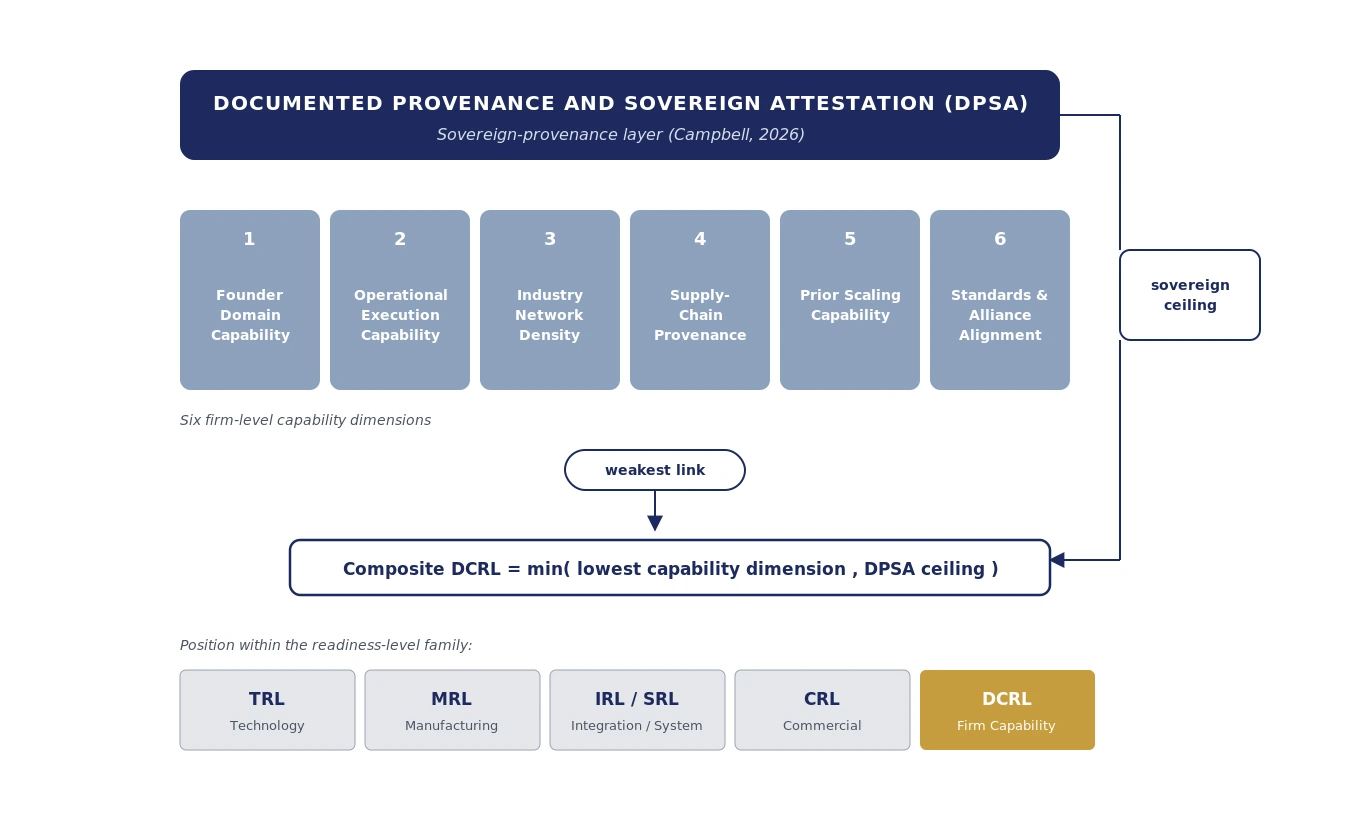
Figure 1. The Dynamic Capability Readiness Level (DCRL) framework. The Documented Provenance and Sovereign Attestation (DPSA) layer - our synthesis of Campbell's (2026) MBOM-PQC, PQC-Safe Signing and Attestation Pipeline, and SCAMM - functions as a ceiling on the composite score generated by the six capability dimensions. The default weakest-link scoring rule is shown. DCRL's position within the parallel readiness-level family is shown at bottom.
Above the six dimensions of DCRL sits Documented Provenance and Sovereign Attestation (DPSA). DPSA is our own term; it abstracts across three artifacts developed by Campbell (2026) - MBOM-PQC provenance, the PQC-Safe Signing and Attestation Pipeline, and the five-level Supply Chain Assurance Maturity Model (SCAMM) - and positions them collectively as a sovereign-layer ceiling within the DCRL firm-capability framework. In AI, cryptography, and other national-security-adjacent technologies, the executing materials - models, data, dependencies, cryptographic engines, hardware roots of trust, and software components - must be verifiable and interoperable. A firm may be talented and fast, but if its stack cannot be attested in a way a sovereign buyer can trust, its capability is not fully usable for public or defence purposes. For that reason, the provenance layer should operate as a ceiling on the overall DCRL score.
A practical scoring rule would use the weakest-link principle: the composite DCRL should not rise above the lowest critical capability dimension or above the sovereign-provenance maturity ceiling. This avoids averaging away a binding weakness. A firm with strong founders but weak supply-chain provenance, or strong standards access but poor operational execution, should not be treated as uniformly ready. The purpose of DCRL is not to produce a flattering score; it is to expose the constraint(s) that matters most for eventual success when risks are being addressed by the use of public funding and program management. DCRL mitigates TRL risks by ensuring ongoing capabilities to maximize use cases that can be planned and counted on in operations.
A design caution applies. Dimensions such as Prior Scaling Capability and Industry Network Density must be scored as evidence of capability (the founders' prior scaling experience in any earlier role; standards-body work held or currently underway by named team members) rather than as pedigree requirements (prior exits by the current firm; an established enterprise customer roster), or the framework risks reintroducing the incumbency bias it is designed to correct. Under the weakest-link composite rule, a single dimension scored as pedigree will suppress the composite score for capable dynamic young firms - the very firms DCRL is designed to surface. Scoring rubrics must therefore anchor each dimension on transferable capability evidence, not on institutional CV markers.
A full anchored rubric - level descriptors, evidence requirements, and worked scoring examples across all six dimensions - has been developed and will appear in the extended version of this framework.
Implementation in Canadian Programs
DCRL can be adopted without creating a new federal program or rewriting procurement systems. The first step is to add weighted, capabilities-augmented merit scoring to existing innovation and procurement evaluations. Where programs currently assess and gate corporate capability through size, revenue, references, and financial history, DCRL would add a structured assessment of founder knowledge, execution history, network access, provenance discipline, and standards alignment. In markets yet to be defined, or capabilities that must be accessed and adapted quickly, DCRL scoring should be weighted heavily.
Second, DCRL could create alternative qualification pathways for capability-rich but currently scale-constrained firms. Scale is a fair test in mature markets; dual-use and defence markets, by contrast, do not scale easily in their initial environments. Minimum headcount, matching-funding, and revenue requirements need not disappear, but they should not be the gate (often an early gate) that removes capable firms from serious consideration. A small firm with unusually strong dynamic capability may merit a staged investment, pilot pathway, or procurement partnership even where it lacks incumbent-style indicators - every successful start-up has passed through exactly this phase, and the added friction of classified, complex, and interoperability-heavy requirements should not disqualify high-functioning, motivated founder teams from tackling them.
That said - DCRL is not an argument for directing public funds toward smaller or newer firms as such, nor for adding money to existing envelopes. It is an argument for changing what is assessed at entry and most importantly what is demanded after it. Where markets and use cases are not yet defined, taxpayer-funded programs cannot anchor selection in firm and customer financial profiles. They must instead assess the demonstrated priors of the founders and teams involved - and then hold those teams accountable for both delivery and adaptation. A DCRL-gated award should therefore carry explicit, staged obligations: a mission or problem statement set with the funding authority, working prototypes delivered against use cases the firm proposes and refines within that mission, and progression gates at which continued funding depends on demonstrated results rather than compliance artifacts. Capability opens the gate; delivered outcomes keep it open. In this sense DCRL is not a relaxation of accountability but a relocation of it - from paperwork that proves a firm resembles an incumbent, to evidence that the team is converting public capital into demonstrated capability and reusable knowledge for downstream mission use.
Third, DCRL would formalize assessments that already occur informally. Experienced program officers and technology advisors often do consider team quality, credibility, domain insight, and execution capability. The problem is inconsistency and weighting: visible marks of financial and adoption progress are overweighted, while leading indicators of innovation capability are underweighted. A structured DCRL rubric would make those judgments more transparent, comparable, and auditable across programs and regions - surfacing capable founder teams that TRL-only assessment tends to exclude. This tool may also help better analyze failures and successes informing future program designs.
Finally, DCRL could support Canadian-content and allied-procurement strategies. Prime contractors and public buyers should be able to recognize a small Canadian firm as strategically capable even where it is not yet large. A capability score that translates into allied procurement vocabularies would also help Canadian firms participate more credibly in NATO, NORAD, EU, bilateral, and other allied innovation channels.
Conclusion
Canada's emerging-technology challenge is not addressed by spending more - it must better assess and allocate scarce dollars. TRL remains useful for the problems it was designed to solve, but it is too narrow to serve as the primary filter for dynamic, dual-use, emerging technologies. In these markets, the decisive question is often not whether an artifact is mature today, but whether a firm can learn, integrate, govern, scale, and adapt faster than the environment or battlefield changes. This requires changes in program management based on DCRL principles.
A Dynamic Capability Readiness Level framework would help funders dynamically assess human and network capabilities rather than overweighting the number of employees, existing customers, cash flow prospects and current revenues. It would give public funders and procurers a disciplined methodology to identify the firms most likely to convert ideas and emerging technology into use cases and abilities that create sovereign value. For a middle power, an analytical edge matters.
The logical institutional extension of this argument is a Canadian mission-oriented agency modelled on OSRD/DARPA (USA)/ARIA (UK)/SPRIND (Germany), with a set of military, AI, quantum-readiness and PQC operations as first defined missions. While this lies outside of the scope of this current paper, any such agency would need precisely the capability-based selection instrument and institutional muscles DCRL helps provide.
The next step is specific: one federal emerging-technology program stream should pilot DCRL as a weighted supplementary score in its next evaluation cycle, with outcomes instrumented from the first cohort.
A full framework paper - setting out the scoring architecture, the sovereign-provenance layer, and an implementation pathway across the federal innovation program suite - is forthcoming, and the authors will make the complete rubric available to any program office prepared to pilot it.
Canada may not be able to outspend larger competitors, but it can still out-evaluate and out-allocate them.
Selected References
Barney, J. (1991). Firm resources and sustained competitive advantage. Journal of Management, 17(1), 99-120.
Campbell, R. (2026). AI supply chain security: MBOM-PQC provenance, PQC attestation, and a maturity model for quantum-resistant assurance. Systems, 14(5), 593.
Cohen, W. M., & Levinthal, D. A. (1990). Absorptive capacity: A new perspective on learning and innovation. Administrative Science Quarterly, 35(1), 128-152.
Gompers, P. A., Gornall, W., Kaplan, S. N., & Strebulaev, I. A. (2020). How do venture capitalists make decisions? Journal of Financial Economics, 135(1), 169-190.
Gornall, W., & Strebulaev, I. A. (2015). The economic impact of venture capital: Evidence from public companies. Stanford GSB Working Paper No. 3362.
Mankins, J. C. (1995). Technology Readiness Levels: A White Paper. NASA Office of Space Access and Technology.
Sarasvathy, S. D. (2001). Causation and effectuation: Toward a theoretical shift from economic inevitability to entrepreneurial contingency. Academy of Management Review, 26(2), 243-263.
Teece, D. J., Pisano, G., & Shuen, A. (1997). Dynamic capabilities and strategic management. Strategic Management Journal, 18(7), 509-533.
Teece, D. J. (2007). Explicating dynamic capabilities: the nature and microfoundations of (sustainable) enterprise performance. Strategic Management Journal, 28(13), 1319-1350.